In this week’s post, I wanted to find out what happens when you replace bread flour partially or fully with whole wheat flour. So here it is, one recipe, three flour ratios:
- 100% bread flour
- 50% bread flour, 50% whole wheat
- 100% whole wheat
Since I’m new to bread making, I chose an easy, simple recipe for a basic sandwich bread, created by Diana from Sweet Y Salado as the basis of this experiment. I successfully made this bread before in its original format, with 100% bread flour, so I was curious to find out how the different flour ratios will change the outcome.
Here is a link to Diana’s recipe, which I recommend for beginners like me.
Ingredients of the original recipe:
- 1½ cup (360 ml) warm water (100ºF – 110ºF / 37ºC – 43ºC)
- 2 tsp active dry yeast (or 1 packet which is approx. 7 g)
- ¼ tsp white granulated sugar
- 3 tbsp unsalted butter, melted
- 4 cups (640 g) bread flour – variable of this experiment
- 2 tbsp white granulated sugar
- 1/3 cup (43 g or 5½ tbsp) non fat powdered milk
- 1½ tsp salt
Note: In my recipe, I substituted the water with 2% milk since I did not have powdered milk around. I also used salted butter and therefore used slightly less salt (1tsp) in the mix.
Total time start to finish: 2.5-3 hours
Temperature: 16ºC / 60ºF
Humidity: 24%
Here we go!
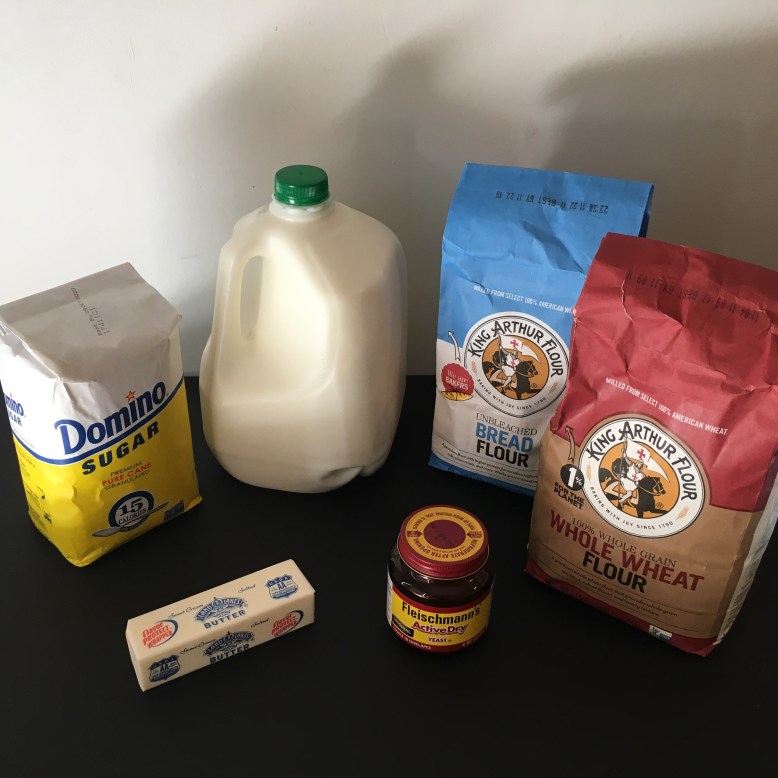
Getting everything close-by – not too many ingredients when you put them side by side
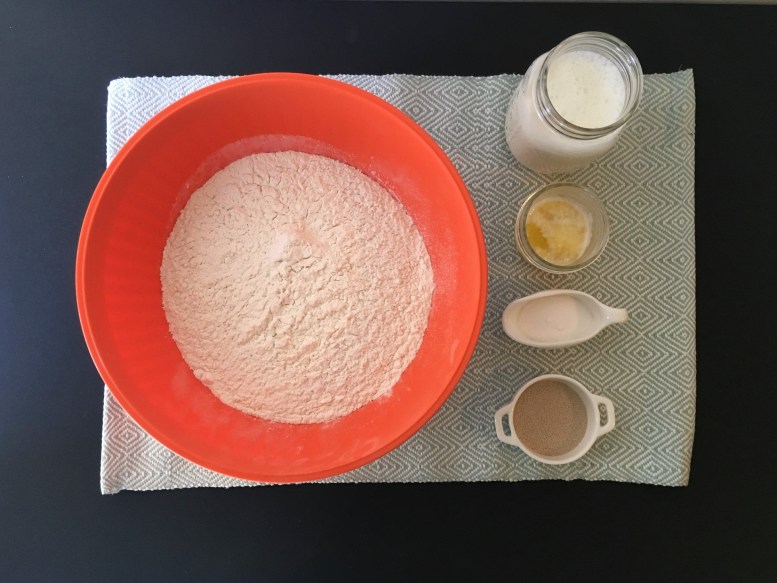
All ingredients measured and ready to go

Yeast activation: I activated each of the 3 bread mixtures for 7 minutes

Colors: I kneaded each dough for 8 minutes. Unfortunately these are all at different stages of proofing so they’re not comparable by size, but the coloring is quite nice to observe. Clockwise from top-left: bread flour; mix of bread and whole-wheat; whole-wheat.

Side by side comparison after first proofing: I left each to proof for 1 hour in the first proof. Below are some more pictures for comparison.


Side by side comparison after second proofing: At this point it is obvious that the white bread is much larger in size. Surprisingly though, the mixed loaf looks quite deflated, which may be a result of my clumsy folding of the dough prior to this proofing.

The final outcome: from left to right: bread flour; mix; whole-wheat. Not much difference from the second proofing sizes. Bread flour is much bigger, but surprisingly mix and whole-wheat were fairly similar in size.

Cross section side by side: in same order, bread, mix, whole-wheat. Some nice coloring seen in the final result as well. Though I also learned I need to work no my seams, since I left a big seam in the middle of the white bread and barely spared the whole-wheat. Live and learn…
Some details related to the process:
- Deviations from the original recipe:
- I used milk instead of water and powdered milk.
- I used salted butter which I compensated with using 1 teaspoon salt in the dry mix versus 11/2 teaspoons per the original recipe.
- Yeast activation: I let each of the mixtures sit for 7 minutes to activate the yeast
- Kneading: 8 minutes. Note: the white bread dough was very dry, so I added another tablespoon of milk during kneading. One thing I noticed was that higher whole-wheat proportion resulted in a wetter dough.
- First proofing: 60 minutes
- Second proofing: 45 minutes
- Baking: 40 minutes (20 minutes uncovered, 20 minutes covered)
Outcome:
- As expected, the white bread rose the most. But, surprisingly, the mix and the whole-wheat loaves were fairly similar in size
- There is not much difference in texture, they are equally spongy and elastic
- Coloring is varied, but mix and whole-wheat look very similar to one another
One take-away from this week’s experiment is to make sure you pinch your seams well, that’s definitely something I will be working on next.
Well, that’s today experiment concluded. Leave a comment if you’ve tried any of these variations and how it’s gone for you, I’d be curios to find out.
See you next time!
– Alina
 The Gluten Ratio